


Understanding video poker pay tables is essential for making informed decisions at the casino. Jacks or Better comes in two versions: 9/6 and 8/5. The pay table differs on two lines between the versions, creating a 2.24 percentage point gap in payout. The gap becomes more noticeable over repeated sessions and influences results. Players should read and compare pay schedules, as careful study helps them identify machines that offer long-term value.
Core Structure Of Jacks Or Better
Jacks or Better uses a 52-card deck. Players earn credits when they finish a hand in one of the categories. The game pays out starting from the lowest qualifying pair, with rewards rising up to a royal flush.
| Aspect | Detail |
|---|---|
| Deck size | 52 cards, no jokers |
| Initial deal | Five cards dealt |
| Draw step | Replace discarded cards |
| Minimum winning hand | Pair of jacks |
| Hand ranking order | Fixed standard poker ranks |
| Coin units | Credits per coin |
| Maximum coins per hand | Five coins |
| Royal bonus activation | Five-coin bet required |
| Evaluation timing | After draw completes |
| Randomness assumption | Fair 52-card model |
Defining 9/6 and 8/5 Tables
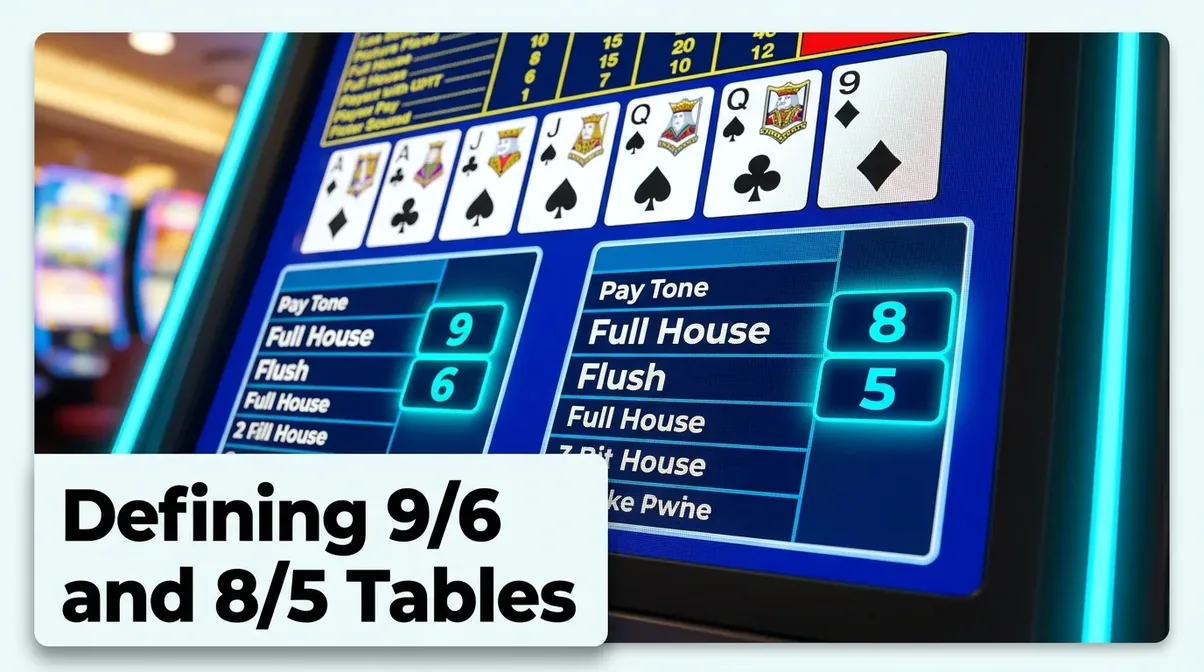
In video poker, “9/6” and “8/5” refer to the payout lines on a Jacks or Better pay table. “9/6” indicates the payouts for a full house and a flush. These two rows distinguish the highest-return version from others with lower payouts. The notation works as follows:
- First number = full house payout;
- Second number = flush payout;
- Values are per coin bet;
- 9/6 pays 9 (full house) and 6 (flush);
- 8/5 pays 8 (full house) and 5 (flush);
- Other standard rows typically match both versions;
- Small numerical shifts alter the total return;
Reading A Jacks Or Better Pay Schedule
A player begins by examining the video poker pay table, starting with the jackpot row. The player then reviews each row in turn until reaching the lowest winning pair. Each row represents a different hand category. The pay table displays the payout for each hand, and these amounts vary with the number of coins wagered. It provides payout values for bets of one to five coins. Each pay table row is described as follows:
- Royal flush – top payout per coin;
- Straight flush – second-tier payout per coin;
- Four of a kind – fixed credits per coin;
- Full house – credits quoted per coin;
- Flush – credits quoted per coin;
- Straight – payout listed per coin;
- Three of a kind – lower fixed rate;
- Two pair – single-credit return;
- High pair (jacks or better) – minimum qualifying payout per coin;
Full House And Flush Payout Changes
Two lines separate the 9/6 jacks or better pay table from the 8/5 jacks or better pay table: the full house row and the flush row have different values in each pay table. All other standard hands are equal across both pay tables.
| Hand | 9/6 Payout | 8/5 Payout | Difference |
|---|---|---|---|
| Royal flush | 800 | 800 | 0 |
| Straight flush | 50 | 50 | 0 |
| Four of a kind | 25 | 25 | 0 |
| Full house | 9 | 8 | 1 |
| Flush | 6 | 5 | 1 |
| Straight | 4 | 4 | 0 |
| Three of a kind | 3 | 3 | 0 |
| Two pair | 2 | 2 | 0 |
| Jacks or better | 1 | 1 | 0 |
Overall Return And House Edge
Return percentage indicates the share of funds returned to the player over time, while house edge reflects the percentage the game retains. Comparison of jacks or better house edge assumes optimal play on every hand. Both versions require close examination of their mathematical figures. Key figures for both versions:
- Return for 9/6: approximately 99.54%;
- House edge for 9/6: approximately 0.46%;
- 8/5 return: approximately 97.30%;
- 8/5 house edge: approximately 2.70%;
- The gap between the two versions equals approximately 2.24 percentage points;
- These figures represent long-run mathematical averages;
- No single session matches either figure with certainty;
Long Term Impact Of Edge Differences
A 2.24 percentage point difference between video poker pay tables can seem minor at first, but the impact of the gap grows with more hands played. The 8/5 version has a 2.70 percent house edge, while the 9/6 version has a lower house edge of 0.46 percent. The house collects more from each wager in the 8/5 game, and the difference becomes increasingly large as play continues. Expected losses grow with the number of credits played:
- At 1,000 credits, 9/6 expected loss: ~$4.60;
- 8/5 expected loss at 1,000 credits: ~$27.00;
- 9/6 expected loss at 10,000 credits: ~$46.00;
- 8/5 expected loss at 10,000 credits: ~$270.00;
- 9/6 expected loss at 100,000 credits: ~$460.00;
- 8/5 expected loss at 100,000 credits: ~$2,700.00;
Royal Flush Bonus Structure
The royal flush is the rarest hand in Jacks or Better. Casinos set a fixed pattern to adjust the royal flush payout across various bet sizes. The payout for the royal flush affects the game’s return percentage. Hitting a single royal flush can have a large impact on long-term results. Games with a strong royal flush payout structure offer top video poker pay tables. The royal flush structure works as follows:
- Per-coin royal value: 800 credits;
- Five-credit bet payout: 4,000 credits total;
- One-credit payout: 800 credits;
- Two-credit payout: 1,600 credits;
- Three-credit payout: 2,400 credits;
- Four-credit payout: 3,200 credits;
- Royal frequency: approximately 1 in 40,000 hands;
- Long-term return contribution: near 1.98% per coin;
Hands That Drive The Payout Gap
Full houses and flushes occur at a combined rate of approximately 2.25% of completed hands. Medium-strength hands appear more frequently than full houses and flushes. On the 8/5 jacks or better pay table, full houses and flushes each pay one credit less.
| Hand Type | Approx Frequency | Effect On Return |
|---|---|---|
| Full house | 1.15% | Largest return loss |
| Flush | 1.10% | Second return loss |
| Straight | 1.12% | No change |
| Three of a kind | 7.44% | No change |
| Two pair | 12.93% | No change |
| High pair | 21.46% | No change |
Strategy Adjustments Between Pay Tables
On the 8/5 schedule, two specific payouts are reduced, so players receive fewer credits for those outcomes. This change affects the expected value for certain close decisions and impacts hands of medium frequency. So players must adjust which cards they keep, since in several situations the optimal hold option changes. The strategy for 8/5 games differs from that used for 9/6 versions, with these key decisions:
- High pair beats flush draw;
- Break low pair for strong flush draws;
- Four to a flush beats single high cards;
- Retain a straight draw over a low pair;
- Chase royal draws over made straights;
- Hold two high cards over weak flush draws;
- Four to a straight loses to high pairs;
- Avoid marginal flush draws in 8/5 play;
Probability Framework For Jacks Or Better
Every video poker pay table decision depends on combination counts, draw trees, and hand probabilities, allowing a person to assign a value to every possible way to hold cards within the 52-card sample space. Final hand probabilities follow from the number of possible five-card combinations. Rarer hands sit at the top of the pay table, while common hands pay the least.
| Final Hand | Approx Probability | Rarity Note |
|---|---|---|
| Royal flush | 0.0025% | Extremely rare |
| Straight flush | 0.0109% | Very rare |
| Four of a kind | 0.2363% | Rare |
| Full house | 1.1512% | Uncommon |
| Flush | 1.1015% | Uncommon |
| Straight | 1.1229% | Uncommon |
| Three of a kind | 7.4449% | Moderate |
| Two pair | 12.9279% | Common |
| High pair | 21.4585% | Very common |
Variance And Short Session Results
Variance measures deviation of actual results from expected return. The 9/6 and 8/5 Jacks or Better versions have identical variance profiles. Both versions produce substantial swings around expected return and have similar dispersion. Short sessions are unpredictable regardless of pay table selected, and the results of short sessions are influenced by several distinct factors:
- Long losing streaks remain possible;
- Sudden large wins can occur without warning;
- A single royal flush reshapes any short sample;
- A few hundred hands produce statistically noisy results;
- Volatility does not alter the underlying mathematical edge;
- Neither version removes the risk of a negative session;
Common Probability Myths Debunked
Some players think a losing streak means a win will come soon. In fact, every new deal stands alone, because randomness does not remember what happened before. When people learn how video poker pay tables work and see the odds, they can resolve these misunderstandings. Common misconceptions include:
- Machine is due to pay;
- Hands are independent;
- Recent royal reduces odds;
- Streaks carry forward;
- More play guarantees profit;
- Correct strategy fixes pay tables;
- Frequent wins signal better return;
- Visual similarity means equal value;
- Random draws hold no memory;
- Expected value predicts one session;
Bet Size And Denomination Effects
Video poker pay tables show that the percentage return remains constant regardless of credit size. The credit size determines the cash value of each hand. On a Jacks or Better machine, betting fewer than five credits prevents access to the 800-credit royal flush payout. The posted schedule remains unchanged despite the betting restriction. This restriction reduces the mathematical return. The five-credit threshold is a structural rule, and no machine treats the five-credit threshold as optional. Key points about bet size:
- Five credits activate the royal bonus;
- Credits and currency differ in value;
- Lower denominations reduce total cash at stake;
- Fewer coins cut percentage return;
- Total coins played set expected loss;
- Dollar loss scales with denomination size;
Comparing Posted Jacks Or Better Pay Schedules
Players must review video poker pay tables. They look through the rows shown on the screen to identify 9/6 Jacks or Better machines, since the game’s title alone does not provide enough information.
| Item To Check | What To Look For | Why It Matters |
|---|---|---|
| Full house value | Nine credits per coin | Sets base return level |
| Flush value | Six credits per coin | Separates 9/6 from 8/5 |
| Royal per coin | 800 credits per coin | Boosts total return |
| Straight flush | 50 credits per coin | Confirms full schedule |
| Four of a kind | 25 credits per coin | Verifies unchanged rows |
| Denomination | Quarter dollar or higher | Affects cash impact |
| Progressive meters | Separate from base table | Changes effective return |
| Required max coins | Five coins for royal | Activates full bonus |
Worked Example Of 9/6 Versus 8/5 Returns
Expected values for 9/6 and 8/5 Jacks or Better differ under optimal strategy. Players follow optimal strategy and wager equal credits. The difference in payouts leads to varying credit outcomes.
| Version | Return Percent | Total Played | Expected Return | Expected Loss |
|---|---|---|---|---|
| 9/6 table | 99.54% | 1,000 credits | 995 credits | 5 credits |
| 8/5 table | 97.30% | 1,000 credits | 973 credits | 27 credits |
| Difference | 2.24 points | Same amount | 22 credits less | 22 credits more |
Practical Play Guidelines For New Players
New players use a checklist for decision-making. The checklist identifies video poker pay tables and prevents errors in the decision-making process. Each checklist item corresponds to a specific decision. Follow these steps in order:
- Check the full house line first.
- Confirm the flush payout on the same screen.
- Verify the royal flush credit amount at five coins.
- Select the table with the higher full house and flush values.
- Set the bet to five credits at the start of every hand.
- Use a printed strategy card matched to the exact table.
- Avoid switching tables mid-session without rechecking the posted schedule.
- Record the payout numbers at the start of each session.
Conclusion
The 9/6 jacks or better pay table offers a return of 99.54 percent. In comparison, the 8/5 jacks or better pay table provides a return of 97.30 percent. Choosing the 8/5 version instead of the 9/6 version increases the house edge by 2.24 percentage points.
FAQ
What Defines A Full Pay Table?
Full pay video poker pay tables apply the highest standard payouts: key hands such as full houses and flushes receive payouts without reduction.
Why Do Small Payout Changes Matter?
A 1-credit cut in both full houses and flushes is central to 9/6 vs 8/5 Jacks or Better. Because frequent hands like full houses and flushes appear across thousands of rounds, this 1-credit cut builds a large expected gap.
Is It Worth Hunting For Better Pay Tables?
Players aiming to reduce long-term losses can choose 9/6 Jacks or Better machines. This choice does not guarantee a profit or any specific result.