

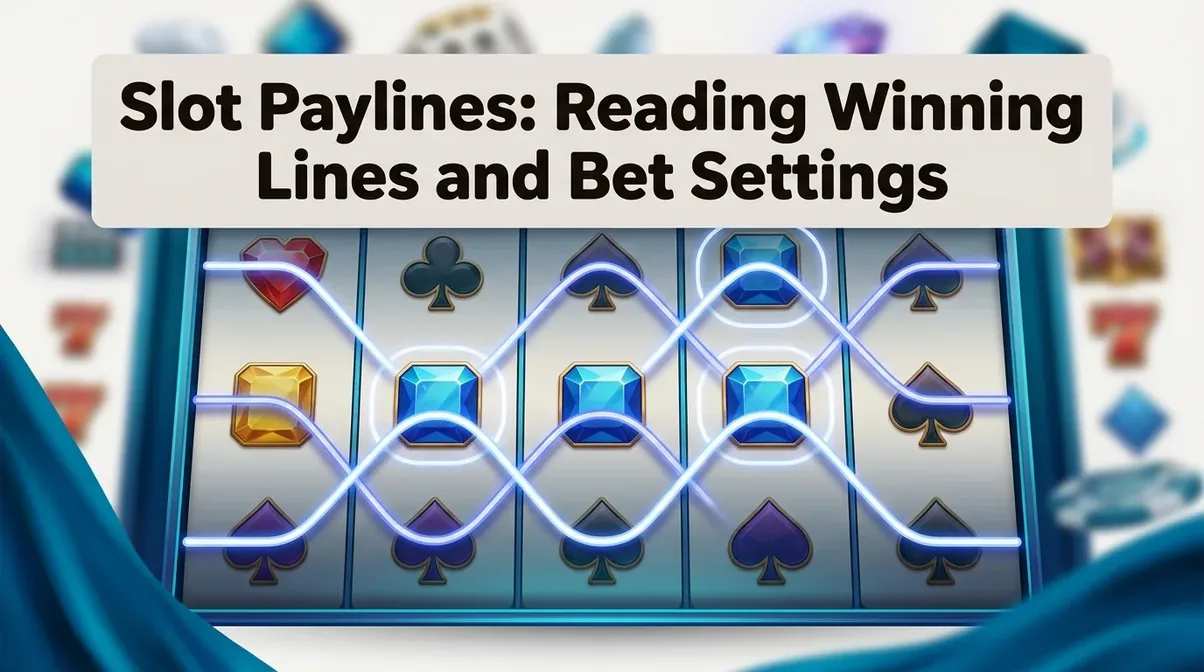
A payline is a defined path across the reels. Matching symbols on a payline produce a payout. Understanding slot paylines is important for new players and experienced gamblers, as paylines relate to bet-per-line calculations and are connected to total bet settings. Slot paylines are also linked to symbol behavior.
Core Mechanics at a Glance
When players understand how slot paylines work, they set their bets with confidence, recognize how paylines influence wins, and observe how games create winning combinations. This knowledge also helps players avoid mistakes.
| Aspect | Clarification |
|---|---|
| Line path | Fixed symbol route per reel |
| Direction | Left to right standard |
| Minimum matches | Two or three symbols |
| Bet-per-line link | Line bet scales awards |
| Total bet | Line bet times active lines |
| Fixed lines | Always active every spin |
| Adjustable lines | Player selects active count |
| Ways-to-win | Adjacent reels replace paths |
| Scatter evaluation | Ignores standard line paths |
| RNG timing | Result set prior to evaluation |
| Wild substitution | Replaces designated regular symbols |
| Volatility effect | Affects award distribution spread |
Line Geometry Across Slot Games

Games released include 3-reel classics and complex grids. Complex grids have over 100 distinct routes. Understanding slot paylines involves recognizing varying winning path geometries, and these winning path structures differ across games. Certain configurations appear in specific games:
- Straight horizontal lines;
- Diagonal zigzag patterns;
- V-shape and inverted V routes;
- Reel counts from 3 to 7;
- Line counts from 1 to 100+.
How to Read a Slot Paytable
A slot paytable shows payout amounts, symbol guidelines, and bonus requirements. It lists all the information necessary for placing bets. The following text outlines the paytable in this order:
- Open the info screen: tap or click the information icon on the slot interface.
- Locate symbol values: find each symbol image and note the matching payout amounts beside it.
- Spot payout calculation type: check whether awards use the line bet or the total spin bet.
- Read wild and scatter rules: find the dedicated section explaining substitution and scatter award conditions.
- Learn how to read a slot paytable for bonus notes: review any listed special feature conditions, multiplier values, and free spin rules.
How the Game Identifies Winning Combinations
The game applies a fixed evaluation sequence to every active line for each spin. After the reels stop, the engine checks each active line against the result, using direction rules that include left to right and both ways paylines. Symbol sequences qualify for a payout based on these direction rules:
- Start reel: sequence begins on reel one;
- Adjacency: symbols occupy consecutive reels;
- Minimum symbols: 2 or 3 matches required;
- Wild substitution: wilds replace designated regular symbols;
- Scatter independence: scatters pay outside active lines;
- Highest win per line: only the top award credits per line.
Fixed Lines and Adjustable Lines Compared
Some slot games keep all lines active. Other games allow the player to choose between fixed and adjustable paylines. In adjustable payline games, the player decides how many lines stay active. Understanding the difference between fixed and adjustable paylines helps the player control spin costs.
| Line Type | Player Control | Main Effect |
|---|---|---|
| Fixed paylines | Stake adjustment only | Constant path count |
| Adjustable paylines | Line quantity selectable | Variable path count |
| Fixed paylines | No line removal | Higher base cost |
| Adjustable paylines | Full quantity control | Lower minimum cost |
Bet-Per-Line Calculations
Many new players confuse bet per line with total bet, which affects their expectations for payouts. The line stake determines the payout for each active line on a single spin. Each step covers one calculation action. Work through them before pressing spin:
- Set a line amount: choose a fixed dollar value for one active line, such as $1.
- Multiply by lines: multiply that line value by the total number of active lines to get the full spin cost.
- Check payout scaling: compare how awards grow with a rising line stake.
- Verify displayed figures: confirm the screen total matches the manual calculation.
Total-Bet Settings
Most modern slot games display one total amount per spin, which simplifies the view for players. Quick bet adjustments are available through dedicated buttons, and the full bet updates instantly on screen. Players must carefully check each control, as several controls require checking before each session:
- Bet buttons: plus and minus controls that change the stake per spin;
- Quick levels: preset bet amounts for rapid selection;
- Confirmation display: the final total shown prior to the spin;
- Paytable value impact: how each stake change scales listed award amounts.
Coin Value and Bet Structure in Slot Games
Coin value in slots affects how betting units convert to real money per spin. Players can adjust both the coin value and the coins-per-line settings. The coins-per-line settings multiply the stake across active lines.
| Setting | Effect | Player Focus |
|---|---|---|
| Raise coin value | Higher cost per line | Budget management |
| Lower coin value | Reduced total stake | Longer play sessions |
| Add coins per line | Multiplies line cost | Payout size increase |
| Remove coins per line | Cuts spin total | Lower risk per spin |
| Change active lines | Alters qualifying paths | Line coverage balance |
Line-Based Designs vs. Adjacency Systems
Paylines and ways to win models determine how combinations are counted, each with distinct direction rules and position requirements. Players often inquire about paylines versus ways to win when choosing a new slot game. Classic fixed-path designs calculate wins along set geometric routes, while adjacency-based systems count symbol positions across reels.
| Model | Positions Needed | Direction Rule | Count Example |
|---|---|---|---|
| 20-line slot | Exact path match | Left to right only | 20 fixed routes |
| 243-ways slot | Adjacent reels only | Left to right only | 243 arrangements |
| 1,024-ways slot | Adjacent reels only | Left to right only | 1,024 arrangements |
| Megaways slot | Variable reel rows | Left to right only | Up to 117,649 ways |
Direction Rules for Winning Combinations
Direction rules determine the starting point for combinations on the reels. Some games use paylines that run from left to right, while others allow winning combinations in both directions. Certain games follow reversed patterns, and some rely on center-based setups. The list below names the distinct types a player will encounter:
- Left-start only wins;
- Both-side wins accepted;
- Center-focused line paths;
- Right-start reversed sequences;
- Scatter-anywhere exceptions.
How Special Symbols Shape Payouts
Different symbol types interact with lines and ways-to-win systems, and their interactions can produce awards beyond standard matches or modify how slot paylines behave. Each symbol role has distinct rules affecting the final credited amount. The paytable defines the conditions related to symbol roles, and symbol roles interact with line and ways-to-win systems in distinct ways. The key symbol roles and features that affect payout outcomes:
- Regular icons: form standard line combinations;
- Wild substitutions: replace qualifying regular symbols;
- Expanding wilds: extend across additional reel positions;
- Scatter pays: award credits regardless of line paths;
- Bonus triggers: activate separate feature rounds;
- Multipliers: increase the value of qualifying awards.
What Does RTP Indicate Mathematically?
Theoretical return to player is the percentage of total bets returned by a slot machine. This percentage is calculated over a large number of spins, and results from a single session or a few hundred spins can vary significantly from the long-term figure. Several specific ideas are linked to the concept of theoretical return to player:
- Sample size: millions of spins establish the statistical average;
- House edge: the percentage retained by the slot after all awards;
- Identical versions: the same game on different sites carries different settings per site;
- Short-term variance: results across 100 spins deviate widely from the stated percentage;
- Probability and paytable values: the theoretical figure combines symbol-combination frequency with award amounts for every possible outcome.
How Outcome Distribution Shapes Results
Return to player measures long-run average payback. However, this measure addresses only one aspect. A separate measure defines how wins and dry spells arrange themselves across a session. The second measure describes the spread of outcomes, not the total returned amount. Two games can share identical return figures and still produce entirely different result patterns. The concepts below outline the key categories a player reviews before selecting a game:
- Low-risk patterns reward often;
- Higher-risk patterns reward rarely;
- Hit frequency tracks award occurrence rate;
- Bonus dependency raises feature reliance;
- Bankroll swing expectations reflect result range.
How the RNG Determines Outcomes
The random number generator determines the outcome before checking line patterns and establishes the result before the reels display symbols. The order of RNG-based slot results is central to the function of slot paylines:
- Each spin result is statistically independent;
- Seed values initialize every number sequence;
- Certification tests verify statistical randomness distribution;
- RNG values map directly to reel positions;
- No memory of past spins exists;
- Chi-squared tests confirm output quality;
- Recognized test batteries validate the full system.
How Bonus and Progressive Mechanics Work
Jackpots and win multipliers offer additional ways to receive payouts in the base game, but do not affect the odds for each symbol combination on a payline. Free-spin rounds and wild modes operate independently of line wins. Players must place a minimum bet to qualify for certain jackpots. The following feature types appear across a wide range of slot games:
- Progressive pots: jackpot pools that grow with each bet;
- Fixed jackpots: set award amounts that do not change;
- Win multipliers: values that scale qualifying payouts upward;
- Free-spin rounds: bonus spins with modified reel rules;
- Expanded wild modes: wilds that extend across full reel positions.
Common Beliefs About Paylines That Contradict Probability
Many players believe slot paylines control outcomes, and some think earlier spins can affect the next outcome. In reality, each spin is independent. Past results do not influence future outcomes. Probability theory and RNG design disprove these myths:
- Due wins after losing streaks;
- Hot reels producing better results;
- Compensation following missed combinations;
- Higher line counts as profit guarantees;
- RTP as a short-term payout promise.
Practical Spin Example
A 20-line slot machine requires a $1 wager on each line, so each spin costs $20. When a winning symbol combination lands, you receive 20 times your bet for that line.
| Element | Value | Result |
|---|---|---|
| Active lines | 20 lines | Eligible paths set |
| Line stake | $1 per line | Base award unit |
| Total spin cost | 20 × $1 | $20 spent |
| 3-symbol hit | 20× line stake | $20 returned |
| 4-symbol hit | 50× line stake | $50 returned |
Should You Play All Paylines?
Some slot games let players lower the number of lines they use. This affects how often winning combinations appear and changes the cost for each line. Using fewer lines means you pay less per spin, but you have fewer ways to win on the reels. The pros and cons break down across a few key points:
- Full coverage: all patterns stay active;
- Lower per-line stakes: fewer lines reduce total spin cost;
- Missing rare patterns: deactivated lines skip low-frequency combinations;
- Bankroll fit: smaller budgets benefit from reduced line counts;
- Should you play all paylines: larger budgets favor full activation for maximum route coverage.
Adjusting Bet Amounts for the Best Slot Bet Settings
Bet amounts, line counts, ways counts, and coin values each shape how long a session can last and what a player might win. Players adjust these settings to fit their budget and preferences, choosing slot bets that match their goals:
- Paytable check: open the paytable and confirm whether awards reference the line bet or the total spin bet.
- Line count adjustment: raise or lower the active line or ways count where the game allows it.
- Coin value selection: set the coin value to a figure that fits the available session budget.
- Total confirmation: read the displayed total-per-spin amount, then press spin.
- Reassessment step: return to step one and recalibrate after any notable win, loss, or budget change to maintain the best slot bet settings.
Comparing Games Beyond Graphics
Slot machines rely on two primary structures: paylines and ways to win. Line counts, ways totals, RTP figures, and volatility highlight differences in slot games’ mathematical profiles. Paylines and ways to win differ in cost and frequency profiles.
| Game Type | Lines/Ways | RTP Level | Volatility Note |
|---|---|---|---|
| Classic 3-reel slot | 1–9 fixed lines | Below 95% typical | Low frequent small wins |
| Multi-line video slot | 20–50 fixed lines | 95%–97% range | Medium balanced award spread |
| Ways-to-win slot | 243–1,024 ways | 96%–97% range | Medium-high varied gap size |
| Megaways slot | Up to 117,649 ways | 96%–97% range | High rare large awards |
Behavioral Psychology and Payline Decisions
Animations, misses, and wins all affect how players interpret paylines. Several factors guide the decisions people make at slot machines. Visual and sensory cues may give the impression of progress, even as the player loses money. If a payout is less than the original bet, the player experiences a loss. Each one deserves attention before a player adjusts bet settings:
- Near-miss effect;
- Small-win reinforcement;
- Sensory cues;
- Rapid clicking;
- Illusion of control.
Key Takeaways for Slot Paylines
RTP, volatility, and RNGs define the math behind every spin. These figures relate directly to how players plan their budgets. Understanding how slot paylines work gives players a foundation for reading line structures. Players can check paytables and set realistic bets:
- Check the math first: verify total bet arithmetic ahead of each spin.
- Read the rules: review paytable definitions for wilds, scatters, and multipliers.
- Compare games: evaluate RTP and volatility separately across different slot games.
- Plan the budget: set a fixed spend limit prior to any bet adjustment.
Conclusion
Understanding slot paylines affects how a gambler approaches each spin. By reading paytables, players can see whether a slot uses fixed or adjustable paylines. Paytables also clarify the distinction between betting per line and wagering on the entire spin. Knowing how coin values and number generation operate allows players to make informed decisions instead of relying on guesses. This understanding helps players compare reels and identify possible ways to win.
Frequently Asked Questions
What a Payline Is?
A payline runs across the reels. When the reels stop spinning, the game examines each payline, and winning occurs with matching symbols along the paylines.
Which is Better: Line Stake vs. Total Spin Cost?
Bet per line indicates the cost for each path. Every path comes with its own line stake. Multiply the line stake by the number of paths to find the total bet. This total is the spin cost.
Does Activating More Slot Paylines Raise Returns?
Adding more paylines to a slot increases the amount spent on each spin. The hit frequency also shifts with this change. Still, the math model determines the return, so the number of paylines does not alter it.