

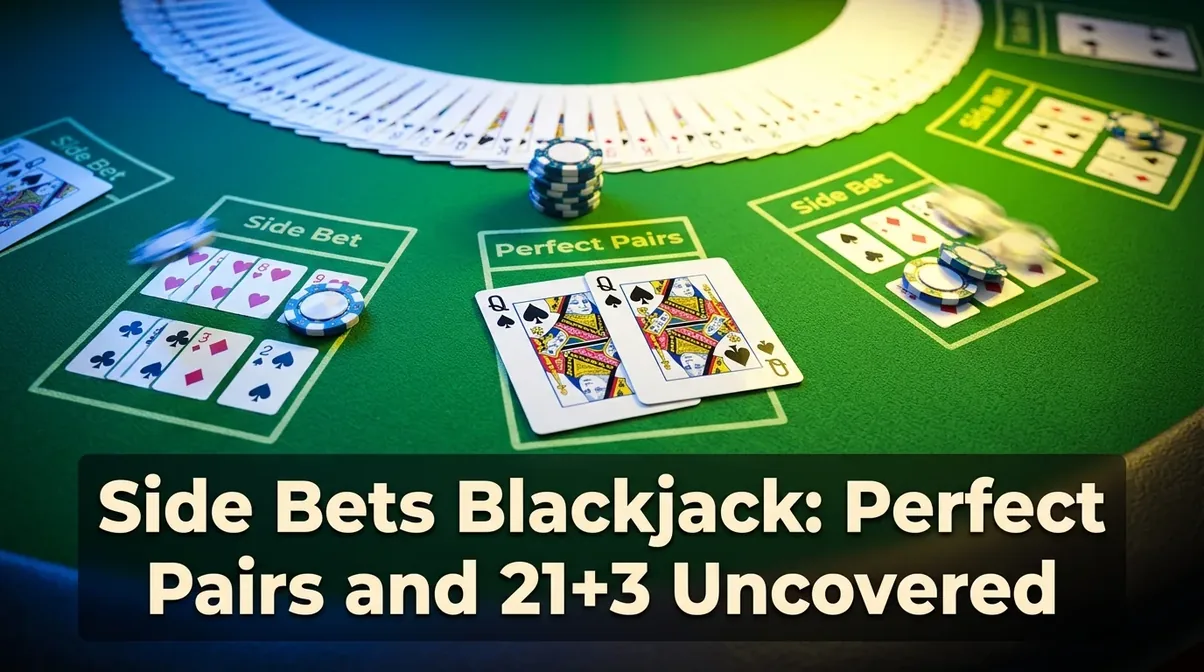
Blackjack offers two optional side bets. Perfect Pairs pays when the player’s first two cards are identical in rank and suit. The 21+3 side bet combines the player’s two cards with the dealer’s upcard to create a three-card poker hand. Each side bet is settled separately from the main hand.
Core Concepts Of Blackjack Side Bets
Side bets are optional bets in blackjack. Each side bet follows a set of rules and has structural characteristics that distinguish it from the primary game.
| Aspect | Explanation |
|---|---|
| Bet timing | Placed at the start of the round, prior to the deal |
| Cards involved | First two player cards |
| Independence from main result | Wins and losses separate |
| Typical bet size | Smaller than main bet |
| Payout style | Fixed odds per category |
| Eligible hands | Specific rank combinations only |
| Perfect Pairs focus | Matching rank pair required |
| 21+3 focus | Three-card poker hand |
| side bets blackjack | Optional bets beside main |
Ideal Players For Blackjack Side Bets

Players who use side bets tend to have certain traits. They include side bets as part of their overall play. The traits below outline the characteristics that align with regular use of Perfect Pairs and 21+3:
- High risk tolerance – accepts larger house edges;
- Seeks extra action – wants bets beyond the main hand;
- Understands probabilities – reviews frequency and payout data;
- Adequate bankroll – sustains both side and main bets;
- Comfortable with variance – accepts streaks without side-bet wins;
- Interested in poker outcomes – enjoys three-card combination results.
How Perfect Pairs Works
To resolve Perfect Pairs, a player must understand each step from placement to settlement. The steps cover the full sequence from deal to payment, and the process runs independently from all later card decisions. Perfect Pairs is one of the fastest-resolving side bets in blackjack. The steps below cover the full sequence from deal to payment:
- Place the bet. Put the Perfect Pairs bet on the designated spot at the start of the round, prior to the deal.
- Examine two cards. Check only the player’s first two dealt cards.
- Compare ranks. Confirm both cards share an identical rank.
- Check suits and colors. Determine the matching tier by suit or color.
- Settle the bet. Collect or lose the bet immediately after the initial deal.
- Ignore later cards. Hits, doubles, and dealer draws do not affect the result.
Perfect Pairs Winning Pair Types
Perfect Pairs separates outcomes into three groups. It compares the rank, color, and suit of the two starting player cards to measure their similarity. The payout varies depending on how closely the cards match.
| Pair Type | Card Requirements | Short Example |
|---|---|---|
| Mixed Pair | Same rank, different colors | King hearts + King spades |
| Colored Pair | Same rank, same color, different suits | King hearts + King diamonds |
| Perfect Pair | Same rank, identical suit | Ace spades + Ace spades |
Perfect Pairs Payout Examples
Casinos create various net-odds structures as they design their payout tables. Each payout schedule lists the values assigned to the three pair categories. The difference between the highest and lowest payouts affects the expected returns.
| Schedule Name | Mixed Pair | Colored Pair | Perfect Pair |
|---|---|---|---|
| Standard Schedule A | 5 to 1 | 10 to 1 | 25 to 1 |
| Standard Schedule B | 6 to 1 | 12 to 1 | 30 to 1 |
| Reduced Schedule C | 4 to 1 | 8 to 1 | 20 to 1 |
Key Differences Between Perfect Pairs And 21+3
Perfect Pairs and 21+3 are different side bets: each side bet evaluates a different card set and uses separate qualifying criteria. Distinct results are produced by each side bet regardless of the hand in play.
| Aspect | Perfect Pairs vs 21+3 |
|---|---|
| Cards used | Two player cards vs three cards |
| Outcome type | Pair rank and suit vs poker hand |
| Top payout range | 25 to 1–30 to 1 vs 100 to 1 |
| Dependence on dealer card | No dealer card vs upcard required |
| Hand style | Matching pair vs poker combination |
| Volatility | Lower variance vs higher variance |
How 21+3 Works
The outcome is determined by evaluating a three-card combination using poker-style rankings. Each result matches a pay table set by the casino. The dealer reviews the outcome, settles the bet based on the result, and pays or collects accordingly. The steps below cover each stage of the bet, including placement and resolution:
- Place the bet. Put the 21+3 bet in the designated circle at the start of the round, prior to the deal.
- Identify the three cards. Take the player’s first 2 cards and the dealer’s upcard as the hand.
- Rank the combination. Check those 3 cards against all side bets blackjack 21+3 qualifying categories to find the best result.
- Collect the payment. Receive a payout for any qualifying combination at posted odds.
- Confirm the main hand. Note that the blackjack result does not alter 21+3 settlement.
21+3 Winning Hand Types
The 21+3 bet relies on specific qualifying hand types. The site applies traditional poker rankings to three-card blackjack hands. Each possible combination has a distinct probability, which determines the payout structure.
| Hand Type | Rank Description | Simple Example |
|---|---|---|
| Flush | Same suit three cards | 3 5 9 hearts |
| Straight | Three consecutive ranks | 7 8 9 mixed |
| Three Of A Kind | Three matching rank cards | Q Q Q mixed |
| Straight Flush | Consecutive same suit cards | 4 5 6 clubs |
| Suited Trips | Identical rank same suit | K K K spades |
21+3 Payout Examples
The number of decks in play affects payouts. Sample 21+3 payouts vary across tables, and the specific casino influences these amounts. Payout schedules can vary dramatically across different venues.
| Schedule Name | Lower Hands | Medium Hands | Top Hand |
|---|---|---|---|
| Tiered Schedule | Flush 5 to 1 Straight 10 to 1 | Three of a Kind 25 to 1 Straight Flush 40 to 1 | Suited Trips 100 to 1 |
| Flat Schedule | All hands 9 to 1 | All hands 9 to 1 | All hands 9 to 1 |
Deck Count Impact On Side Bets
Adjusting the number of decks affects how frequently the same cards appear. This alters both the expected returns and the house edge for side bets. The points below outline specific deck-related trends for each side bet:
- More decks increase Perfect Pairs hit frequency;
- Fewer decks raise Perfect Pairs house edge;
- Single decks make Perfect Pairs nearly unplayable;
- Higher deck counts reduce 21+3 house edge;
- Eight decks lower 21+3 edge to 3.70%;
- Lower deck counts inflate 21+3 edge sharply;
- Six decks set 21+3 edge at 4.62%.
Deck Count Examples For Perfect Pairs
The house edge in Perfect Pairs changes with the number of decks, as more decks increase the chance of matching cards. Depending on deck count, the difference in house edge can exceed 15 points.
| Decks | Example Payout Schedule | Approximate House Edge |
|---|---|---|
| 2 | 25 10 5 two decks | Edge about 22 percent |
| 4 | 25 10 5 four decks | Edge about 10 percent |
| 6 | 25 10 5 six decks | Edge about 6 percent |
| 8 | 25 10 5 eight decks | Edge about 4 percent |
Deck Count Examples For 21+3
Deck-based changes for 21+3 follow a pattern similar to Perfect Pairs. Four deck configurations illustrate the range a player encounters at tables. Exact edge values depend on the specific setup.
| Decks | Example Version | Approximate House Edge |
|---|---|---|
| 2 | Standard 21+3 table | Edge near 11 percent |
| 4 | Standard 21+3 table | Edge near 6 percent |
| 6 | Standard 21+3 table | Edge near 5 percent |
| 8 | Standard 21+3 table | Edge near 4 percent |
Timing Of Side Bet Resolution
The dealer addresses both Pairs and 21+3 before players act on the main hand. Resolution occurs after the initial deal. The table follows this procedure step by step:
- Place bets. Put the side bet and main bet in their designated circles at the start of the round, prior to the deal.
- Receive initial cards. Accept the two dealt cards alongside the dealer’s upcard.
- Resolve Perfect Pairs. Settle the pair bet from the two player cards.
- Settle 21+3. Evaluate the three visible cards as a poker combination and close that bet.
- Play the main hand. Take all standard blackjack decisions afterward.
Connection Between Side Bets And Blackjack Hands
Side bets relate to the main blackjack deal, yet each operates independently and follows its own rules for resolution. While there is a connection between side bets and main bets, the outcome of one does not determine the outcome of the other. The points below cover the key relationship aspects between these two bet types:
- Side bet can win alone;
- Blackjack can win without side bet;
- Perfect Pairs ignores dealer cards;
- 21+3 uses dealer upcard;
- Both bets settle independently;
- Losses on one do not cancel wins on the other;
- Main-hand total does not alter side bet payment.
Independent Outcomes Of Side Bets
A side bet result is independent of the main hand outcome. Each bet relies on its own set of cards. Side bets are resolved independently, and the two bets remain separate, so players can win or lose on either bet.
| Main Hand Result | Side Bet Result | Short Example |
|---|---|---|
| Player busts | Side bet wins | Perfect pair hit |
| Player blackjack | Side bet loses | No qualifying combo |
| Player wins | Side bet loses | Mismatched three cards |
| Player loses | Side bet wins | Suited trips dealt |
| Player pushes | Side bet wins | Flush cards present |
Comparing Different Side Bet Pay Tables
Each posted schedule lists different return values for the same hand categories. The steps below explain this further:
- Check the top payout. Look at the highest-listed return, such as 100 to 1 for suited trips in 21+3.
- Review lower-tier returns. Note the payment for hands like a flush or a Mixed Pair.
- Confirm included hand categories. Identify which specific hands appear on the posted list.
- Record the stated house edge. Write down any published edge figure next to each schedule.
Evaluating Risk And Return On Side Bets
Risk and reward shape each side bet choice. When players understand volatility and expected return, they can set a budget before betting:
- High payouts mean rare hits;
- Frequent small hits feel safer;
- House edge defines long term;
- Short-term streaks can mislead;
- Deck count changes probabilities;
- Pay tables alter expected return;
- Bankroll size limits variance exposure;
- Rarer hands carry steeper edges;
- Flat-rate schedules reduce top prizes.
House Edge Figures For Popular Pay Tables
These house edge calculations are derived from mathematical models that account for both the probability of each hand occurring and the corresponding payout offered by the casino. Understanding these figures helps players identify which pay tables offer more favorable conditions and which ones carry much higher house advantages.
| Bet Type | Decks | Example Schedule | Approximate Edge |
|---|---|---|---|
| Perfect Pairs | 6 decks | 25-12-6 | About 4% |
| Perfect Pairs | 8 decks | 30-10-5 | About 4 percent |
| Perfect Pairs | 2 decks | 25-12-6 | About 22% |
| 21+3 | 6 decks | Tiered five-hand | About 5 percent |
| 21+3 | 8 decks | Tiered five-hand | About 4 percent |
| 21+3 | 2 decks | Flat 9 to 1 | About 11% |
Practical Tips For Playing Blackjack Side Bets
A player can stay in control by following four steps: set a budget specifically for side bets before the session begins and keep the side bet budget separate from the main blackjack stake. These four steps help a player stay in control:
- Set a fixed budget. Decide on a maximum dollar amount for side bets at the start of the first hand.
- Choose tables with better returns. Compare posted pay tables and select the schedule with the lower house edge.
- Avoid chasing losses. Stop placing side bets once the fixed budget runs out.
- Track results. Record how often the side bets actually pay out across the session.
Checklist For Choosing Side Bets
Review this list before joining a blackjack table. It outlines the points that each player should check:
- Confirm available side bets;
- Read full pay tables;
- Note number of decks;
- Check minimum bet level;
- Compare Perfect Pairs tiers;
- Review 21+3 hand categories;
- Verify house edge figures;
- Identify suited trips payout;
- Confirm settlement timing rules.
Common Myths About Blackjack Side Bets
Many players trust false claims about Perfect Pairs and 21+3. This list of checked facts corrects mistakes about these bets. The five rows below correct the most widespread misconceptions tied to these wagers.
| Myth | Brief Reality |
|---|---|
| Always profitable with skill | House edge remains fixed |
| Card counting beats side bets | Counts do not apply |
| More decks hurt all bets | More decks reduce edge |
| Side bet wins boost main hand | Each bet settles separately |
| Flat 9 to 1 pays better overall | Schedule changes expected return |
Facts That Counter Popular Misconceptions
A player benefits from keeping a short set of verified facts in mind, as these facts help avoid common errors in real betting decisions. Key facts are listed below:
- Odds unchanged by bet size;
- Past results do not matter;
- Strategy cannot beat house edge;
- Each deal stays independent;
- Suit patterns follow probability;
- Deck count alters house edge;
- Side bet wins stay fixed;
- Pay tables differ by casino;
- Three-card rank decides 21+3.
Conclusion
Pairs and 21+3 provide additional betting options in blackjack, and each side bet is independent of the main hand. Players can review the functioning of these bets, look at payout tables, examine house edges, and observe the impact of card composition on outcomes.
FAQ
Are Blackjack Side Bets Worth It?
Optional bets have higher house edges than standard blackjack hands. Players can win money from these bets, but they should use them for entertainment rather than as a main betting method.
Can Side Bets Win on a Losing Blackjack Hand?
Both bets use the first cards. Each outcome is decided separately. A player can lose the main hand but still win a Perfect Pairs or 21+3 bet. The results of Perfect Pairs and 21+3 do not depend on the main blackjack hand.
Do More Decks Help Side Bets?
When a game uses more decks, the return on side bets goes up. Card combinations appear more often, so players can reach payouts more easily. Still, the casino keeps the house edge.