

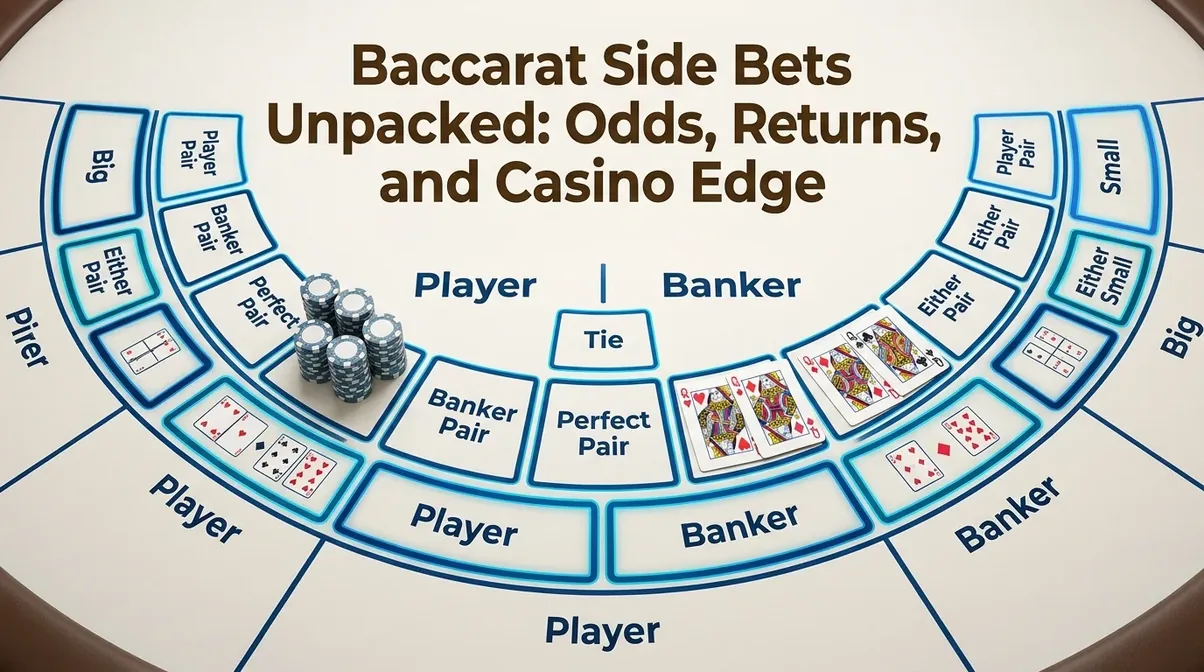
Baccarat side bets allow players to place additional wagers on outcomes such as card patterns, point totals, or winning margins, alongside the main Player, Banker, or Tie bets. Each side bet is resolved independently, meaning its outcome is not influenced by the main bet. Payouts for side bets are higher, but the chances of winning are lower, and the house edge differs depending on the specific side bet. Players require precise definitions, relevant data, comparisons, and an understanding of possible losses before making side bets.
Basics Of Baccarat Side Bets
Baccarat side bets provide additional choices during play. Each side bet settles independently. Available options can vary by table. Understanding how baccarat side bets work starts with recognizing that each wager targets a specific card pattern or total, not a winning side.
| Aspect | Brief Detail |
|---|---|
| Event focus | Specific card patterns or point totals |
| Relation to main bets | Resolves independently from Player, Banker, or Tie |
| Typical payout style | Higher payouts than main bets |
| Usual hit frequency | Lower than main bet frequency |
| Reliance on deck count | Probabilities change with deck count |
| Handling of ties | Can push, lose, or receive separate payout |
| Margin-based payouts | Multiple payout tiers based on winning margin |
| Independence of stake size | Main bet amount does not affect side bet edge |
| Reference calculation standard | Eight-deck combinations used for published figures |
Key Payout Terms
Payout wording can change the mathematical value of any wager. A baccarat side bet payout table must use precise notation, as a single word difference between “to 1” and “for 1” alters the net return. The terms below define each core concept:
- 25:1 – 25 units net profit;
- 25-for-1 – 25 units total return;
- Net payout – profit after stake removal;
- Total return – profit plus original stake;
- Push – stake returned, no profit or loss;
- Multi-tier paytable – separate payout per margin level;
- Natural bonus – distinct payout for natural wins;
- Margin-based schedule – payout tied to winning gap;
- To-1 notation – stake excluded from stated amount;
- For-1 notation – stake included in stated amount.
Understanding Side Bet Probabilities And House Edge
Baccarat side bet probabilities indicate event frequency during hands dealt. Each figure represents the frequency of events, though results of one session can not match expected patterns. The house edge for baccarat side bets reflects average loss per unit wagered.
| Concept | Short Explanation |
|---|---|
| Probability | Long-run event frequency rate |
| House edge | Average loss per unit |
| Return to player | 100% minus house edge |
| Expected value | Net return per bet |
| Variance | Result spread around average |
| Short-term swings | Sessions differ from math |
| Sample size | Hand count affects accuracy |
Player Dragon Bonus Structure And Returns
Player Dragon Bonus is a margin-based side bet in baccarat. Payouts increase as the point difference grows. Separate payout tiers apply for winning margins between four and nine points. If the Player wins with a natural, different payout tiers are used.
| Outcome Type | Indicative Payout and Frequency |
|---|---|
| Natural win | 1 to 1 – approx 1626 per 10 000 hands |
| Win by four | 1 to 1 – rare margin |
| Win by five | 2 to 1 – rare margin |
| Win by six | 4 to 1 – rare margin |
| Win by seven | 6 to 1 – rare margin |
| Win by eight | 10 to 1 – rare margin |
| Win by nine | 30 to 1 – approx 37 per 10 000 hands |
| House edge and return | Approx 265 per 10 000 edge – theoretical return approx 9735 per 10 000 |
Banker Dragon Bonus Structure And Returns
The Banker Dragon Bonus applies a margin-based payout structure to bets placed on the Banker hand. This baccarat side bet carries a house edge of approximately 9.37 percent. In comparison, the Player side features a house edge near 2.65 percent. The key facts about this wager are listed below:
- Event condition: Banker wins by a set margin;
- Payout ladder: 1 to 1 for four-point win, up to 30 to 1 for nine-point win;
- Natural treatment: natural Banker wins pay 1 to 1 under reference rules;
- Hit rate vs. Player: Banker margin distribution is less favorable;
- Approximate house edge: 9.37% on eight decks;
- Approximate return to player: 90.63%;
- Name caution: “Banker” and “Player” share identical payout labels but carry very different expected costs;
- Main point: the name alone does not reflect the unfavorable math behind this bet.
Pair Side Bets On Player Or Banker
Each bet focuses on the first two cards of one chosen hand. The two cards must share the same rank. Selected hand pairs determine the outcome of Player Pair and Banker Pair bets.
| Net Payout | Approximate Probability | Approximate House Edge |
|---|---|---|
| 11 to 1 | approx 747 per 10 000 | 10.36% |
| 10 to 1 | approx 747 per 10 000 | 17.83% |
Either Pair And Its Probability
Players should review the paytable before making a bet. The Either Pair option covers both initial hands at once and roughly doubles the number of winning outcomes compared to a single-hand Pair bet. But more frequent wins do not translate into better expected value. Baccarat side bet probabilities for Either Pair reflect a high house edge. The key figures across deck counts and payouts break down as follows:
- Eight-deck probability sits at approximately 14.38%;
- Six-deck probability reaches approximately 14.24%;
- Typical payout stands at 5 to 1;
- Eight-deck house edge sits between 13.71% and 14.54%;
- Either Pair triggers roughly twice as often as a single-hand Pair;
- Suits do not need to match;
- Higher hit frequency does not reduce the house edge.
Perfect Pair Outcomes And Paytables
In Perfect Pair, the player must get two cards of identical rank and suit in the first hand. Certain versions also award a payout if two pairs are dealt at once.
| Paytable Version | Payout | 8-Deck Probability | House Edge |
|---|---|---|---|
| Standard version | 25 to 1 | approx 335 per 10 000 | 13.03% |
| Improved version | 28 to 1 | approx 335 per 10 000 | 2.99% |
| Two simultaneous perfect pairs variant | Separate bonus tier | Below 50 per 10 000 | Varies by schedule |
Big And Small Total Cards Bets
Baccarat bets depend on the total number of cards dealt in each round. The dealer determines this number while placing the cards on the table. The outcome does not change based on whether the player or the banker wins.
| Bet Type | Win Condition | Probability | Typical Payout | Reference House Edge |
|---|---|---|---|---|
| Small | Four cards dealt exactly | approx 3789 per 10 000 | 3 to 2 | approx 528 per 10 000 |
| Big | Five or six cards dealt | approx 6211 per 10 000 (5-card approx 3034 per 10 000, 6-card approx 3177 per 10 000) | 2 to 1 | approx 435 per 10 000 |
Dragon 7 Side Bet Details
Dragon 7 pays out when the Banker hand wins the round with exactly three cards that total seven points. Both conditions must happen together.
| Aspect | Detail |
|---|---|
| Win condition | Banker wins only |
| Card count required | Exactly three cards |
| Three-card seven ties | Does not qualify |
| Three-card seven loses | Does not qualify |
| Typical payout | 40 to 1 |
| Approximate probability | approx 225 per 10 000 |
| Approximate house edge | 7.61% |
Panda 8 Side Bet Details
The Panda 8 bet pays out when the Player wins with a three-card hand that totals eight points and beats the Banker. If the result is a tie, the house edge and side bet payouts for baccarat remain the same.The seven key facts about this bet are listed below:
- Event condition: Player wins, three cards, total eight;
- Ties: No payout on tied hands;
- Payout: 25 to 1 net on a winning result;
- Probability: Approximately 3.45% per hand;
- House edge: Approximately 10.19% (eight-deck);
- Frequency vs. Dragon 7: Hits more often than Dragon 7 at 2.25%;
- Cost vs. Dragon 7: Pays 25 to 1 versus Dragon 7’s 40 to 1, so each win returns less.
Lucky 6 And Super 6 Comparison
Lucky 6 pays out at different rates for two-card and three-card Banker totals of six. Super 6 covers the same event as Lucky 6 but has different names and payout structures across tables. There are wide house edge gaps between available schedules in baccarat side bet payout tables.
| Schedule Name | Payout Structure and Approximate Edge |
|---|---|
| Lucky 6 – Split Schedule | 12 to 1 for two-card six, 20 to 1 for three-card six – edge approximately 16.68% |
| Super 6 – Low Option | 12 to 1 flat rate – edge above 20% |
| Super 6 – Mid Option | 15 to 1 flat rate – edge approximately 13.82% |
| Super 6 – High Option | 17 to 1 flat rate – edge approximately 3.05% |
4 5 6 Total Cards Options
This baccarat side bet depends on how many cards are in the hand. You may get four, five, or six cards. Each possibility comes with its own probability and house edge. The three outcomes break down as follows:
- Four cards – approx 3789 per 10 000 probability, 3 to 2 payout, house edge approx 5.28%;
- Five cards – approx 3034 per 10 000 probability, 2 to 1 payout, house edge approx 8.97%;
- Six cards – approx 3177 per 10 000 probability, 2 to 1 payout, house edge approx 4.69%.
Deck Count Effects On Baccarat Side Bets
Probabilities and house edges for baccarat side bets change with the number of decks in play. Dragon Bonus and pair bets have different outcomes in games that use four, six, or eight decks.
| Deck Count | Key Probability or Edge Notes |
|---|---|
| 4 decks | Player Dragon Bonus approx 2.70% edge |
| 4 decks | Banker Dragon Bonus approx 9.42% edge |
| 4 decks | Pair probability moves higher |
| 6 decks | Player Dragon Bonus approx 2.67% edge |
| 6 decks | Banker Dragon Bonus approx 9.39% edge |
| 6 decks | Either Pair approx 14.24% probability |
| 8 decks | Player Dragon Bonus approx 2.65% edge |
| 8 decks | Banker Dragon Bonus approx 9.37% edge |
| 8 decks | Either Pair approx 14.38% probability |
Why Paytable Variations Matter For Value
Adjusting a payout schedule can alter the house edge by several percentage points. The same principle applies to baccarat side bets. Players need to review the paytable before placing any bets. The tips below apply to any table comparison:
- Check the full payout schedule.
- Confirm the natural card treatment.
- Verify tie outcomes push or lose.
- Confirm net-to-one vs for-one notation.
- Note Perfect Pair differences: 25 to 1 versus 28 to 1.
- Compare Pair formats: 11 to 1 versus 10 to 1.
- Match deck count to published figures.
- Separate Player-side from Banker-side rules.
Calculating Expected Loss
Use this formula to find a cost estimate: loss equals total stake times house edge. Numbers in the examples below come from a typical baccarat side bet payout table. Each figure reflects a single wager at the stated edge.
| Scenario (Stake × House Edge) | Expected Loss |
|---|---|
| 5 USD at 265 per 10 000 (Player Dragon Bonus) | 013 USD |
| 25 USD at 9.37% (Banker Dragon Bonus) | 2.34 USD |
| 50 USD at 13.03% (Perfect Pair at 25 to 1) | 6.52 USD |
| 100 USD at 16.68% (Lucky 6 at 12 to 1 and 20 to 1) | 16.68 USD |
| 500 USD at 10.19% (Panda 8) | 50.95 USD |
| 1000 USD at 7.61% (Dragon 7 at 40 to 1) | 76.10 USD |
Practical Comparison Standards
Match event definitions and count the decks. A fixed method is required for comparing options across tables. Using a fixed method prevents incorrect conclusions when comparing options across tables and schedules. Each standard below acts as a consistent, accurate comparison across tables and schedules:
- Match event conditions;
- Check deck count;
- Align payout notation (to-one vs. for-one);
- Include every payout tier;
- Separate Player-side from Banker-side results;
- Distinguish selected-hand Pair from Either Pair;
- Confirm Perfect Pair rules separately;
- Split two-card and three-card outcomes;
- Convert house edge into expected loss per 1,000 units staked (a 10.36% edge costs approximately 103.60 units per 1,000);
- Verify probability figures match the exact deck and schedule.
Availability Of Baccarat Side Bets Across Tables
Names may appear in multiple tables. Each table has its own rules and payouts. Both the software and the table format determine which features and options players can use. The list below covers several popular side bet types and notes where each one commonly appears:
- Dragon 7 – found at EZ Baccarat tables as a standard inclusion;
- Panda 8 – paired with Dragon 7 in EZ Baccarat rule sets;
- Big – present in Playtech software families alongside Small;
- Small – offered in Playtech and similar software families;
- Either Pair – common across Playtech-based and select live tables;
- Perfect Pair – appears on live-dealer tables with varied paytables;
- Player Pair / Banker Pair – available across multiple rule sets.
Most Frequently Hitting Bets
Baccarat side bet probabilities indicate how frequently each bet results in a win. The hit rate varies depending on the type of side bet. Still, a higher hit rate does not necessarily reflect a better expected return.
| Side Bet Name | Frequency Label |
|---|---|
| Big | Higher frequency |
| Small | Higher frequency |
| Either Pair | Medium |
| Dragon Bonus naturals | Medium |
| Perfect Pair | Medium |
| Panda 8 | Rare |
| Dragon 7 | Rare |
| Lucky 6 / Banker Six | Rare |
Summary On Baccarat Side Bet Value
To calculate risk, multiply the wager amount by the house edge percentage to determine the expected loss. Each type of bet carries its own house edge. The Banker bet has a house edge of 1.06 percent, and the Player bet has a house edge of 1.24 percent. Adjusting the payout by one unit can change the house edge between 2.99 and 13.03 percent. Players might place side bets for entertainment, but these bets do not increase value.
FAQ
What Is The Safest Baccarat Side Bet?
The optimal choice in pure mathematics is the bet with the lowest house edge. The Banker bet has the lowest house edge, though certain side bets also have low house edges. Perfect Pair pays 28 to 1 and has a house edge of about 2.99 percent.
How Often Do Baccarat Side Bets Win?
Hit rates vary by bet type. Players receive a Pair in single-hand bets about 7 percent of the time. The Big bet wins more than 60 percent of the time.
Are Baccarat Side Bets Worth Playing For Casual Players?
Side bets add variety, but since the house sets their edges, they are better used occasionally for entertainment rather than relied on for value.