

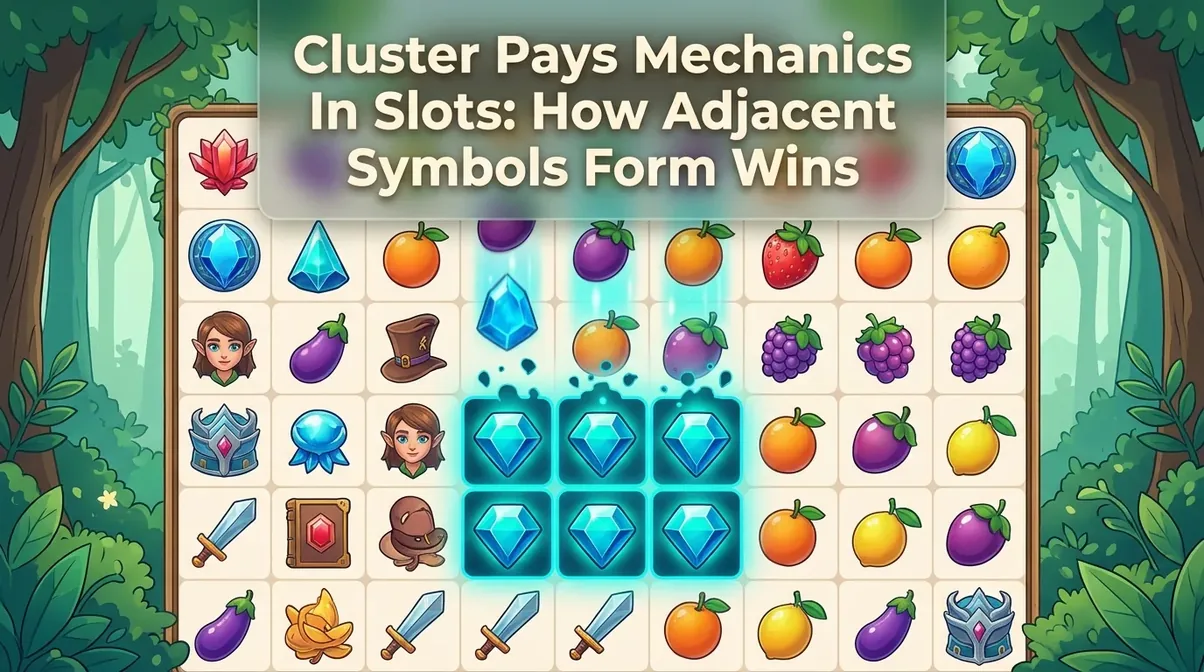
Cluster pays slots replace fixed paylines with a grid layout. Wins occur when enough matching symbols connect, either vertically or horizontally. The payout depends on two factors: the number of linked symbols and their type, both detailed in the paytable. Wild symbols can help form or expand a winning cluster. When you land a win, the symbols involved are removed, and new ones drop into the empty spaces, allowing for additional wins within the same round. RTP indicates the long-term return. Volatility measures how much your results can vary between sessions.
Core Mechanics Of Cluster Grids
In grid-based slots, the cluster pays grid layout determines the rules that players use. To understand how cluster pays function, begin by examining the typical setup in most connected-grid games.
| Aspect | Detail |
|---|---|
| Grid layout size | 5×5 to 8×8 |
| Symbol placement | Random each spin |
| Evaluation timing | After full grid lands |
| Adjacency rule | Horizontal or vertical only |
| Cluster recognition | Connected component scan |
| Per-spin independence | Each spin stands alone |
| Cascade processing | Winning symbols removed first |
| Win accumulation | All clusters combined |
| Special symbol treatment | Wilds and scatters separate |
Defining Cluster Pays Slot Systems
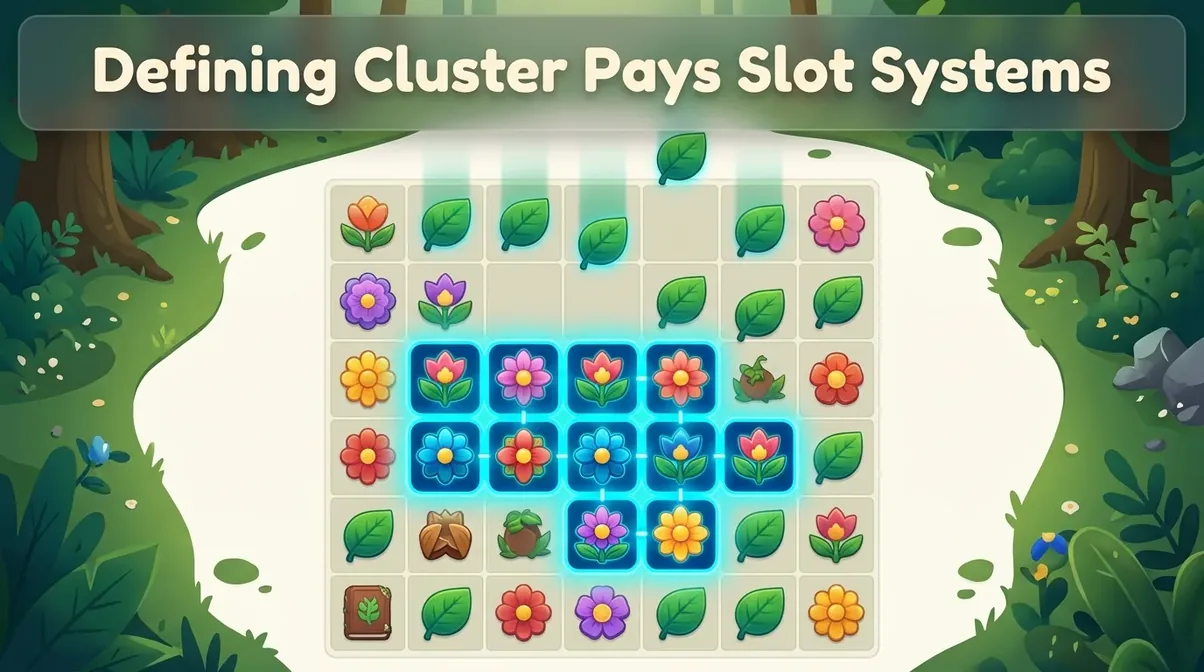
Cluster pays slots award wins when groups of matching symbols appear touching each other, side by side, anywhere on the grid. Unlike games that require matching symbols along set lines, these slots pay out when symbols connect in any position. The game reviews each connected group to determine if it forms a winning cluster. Each defining feature of the format is listed below:
- Connected symbols: each symbol must share a side with another matching symbol;
- No starting reel: a group can begin at any grid position;
- Anywhere-on-grid wins: qualifying groups form across the full grid;
- Fixed minimum cluster: the group must hit a set symbol count;
- Full-grid symbol evaluation: the grid checks all positions after every land.
Adjacency Rules For Connected Symbols
Adjacency in cluster games determines connected groups of symbols. The cluster pays adjacent symbols rule specifies different results based on contact directions. Corner contact between two symbols is not a valid connection in standard rule sets. Adjacency in cluster games includes several distinct contact rules. The following aspects define how adjacency operates across a grid:
- Side contact between two symbols counts as a valid link;
- Vertical contact between upper and lower symbols qualifies as adjacency;
- Diagonal-only arrangements produce no connected group;
- Irregular shapes with side-linked symbols qualify as clusters;
- One group can hold multiple connection paths;
- A valid connection needs no left-to-right starting position.
Minimum Cluster Size And Thresholds
Minimums control the frequency of qualifying groups forming. Each game has different thresholds. A lower threshold produces more frequent wins, while a higher threshold is associated with larger payouts. Understanding cluster size and payouts connects win frequency to award value. The following sizes appear across different games:
- Four-symbol minimums appear in some entry-level grid games;
- Five-symbol minimums represent the most common threshold across popular releases;
- Nine-symbol minimums appear in designs with larger grids and higher award tiers;
- Symbol-specific thresholds exist where premium symbols require fewer connected positions than low-value ones.
Cluster Size And Payout Scaling
Clusters progress through tiers on the paytable. Only clusters that meet specific criteria will influence the award. The paytable lists the required number of symbols and the corresponding value. Each game’s rules screen describes how the size of a cluster affects the payout. Each one below reflects a concrete paytable mechanic:
- Tiers rise with symbol count;
- Premium symbols carry higher per-tier values;
- Maximum cluster equals full grid size;
- Overlapping clusters split into separate evaluations;
- Same-symbol clusters across the grid combine into one total award.
Evaluating Wins With Paytables
Players use the paytable to identify symbol identities, with each symbol linked to its exact award value. The paytable displays tiered payout amounts and total-bet multipliers. Understanding cluster pays requires correctly reading the payout tiers:
- Base symbol tiers: every regular symbol has its own value row sorted by identity;
- Multiplier indication: awards display as total-bet multiples, so a 4× entry on a $1.00 stake returns $4.00;
- Separate feature pay rows: scatter and bonus entries appear in distinct table sections;
- Min and max cluster tiers: the smallest qualifying group and the largest rewarded group each have separate rows;
- Total-spin calculation adds every qualifying cluster award together into one final result.
Cascading And Tumbling Symbol Sequences
When a player forms a cluster, the matched symbols vanish from the grid after the winning cluster pays out. Cascading reels refill the spaces as new symbols fall from above and fill the gaps. Each cascade step follows a defined order, and each cascade produces a fresh grid state evaluated at the same original stake. The points below outline the key concepts:
- Symbol removal: qualifying symbols leave the grid after payment;
- Downward fall: symbols above empty spaces drop to fill them;
- New symbols: replacements enter from the top row;
- Repeated evaluation: the refilled grid checks for new clusters;
- Chain reactions: a second cluster can trigger a third;
- Spin-end condition: no new cluster ends the sequence.
Wild Symbols In Connected Groups
Cluster pays wild symbols and multiplier symbols are found in grid-format games. Each wild symbol type has its own rules, and different games handle wild behavior differently. Wild symbols can substitute for standard matching symbols and help complete groups that do not meet the minimum threshold. Players should check the paytable to understand wild symbol capabilities. Each game handles wild behavior differently across several key areas:
- Acts as any symbol: a wild replaces most regular symbols to complete a qualifying group;
- Multiplier wilds: the wild applies a fixed multiplier to the award value of its cluster;
- Sticky wilds: the wild holds its position through subsequent cascade evaluations;
- Wild generation on wins: a new wild appears on the grid after a qualifying cluster pays;
- Substitution limits: some wilds substitute for a defined set of symbols, not all;
- No scatter substitution: wilds do not replace scatter symbols in any covered game.
Scatter Symbols Outside Clusters
Scatter symbols follow rules that differ from standard cluster evaluation. These symbols do not have to be adjacent. If enough scatter symbols appear on the screen, players are awarded spins or rounds. Each scatter principle below reflects how these symbols differ from regular cluster mechanics:
- Pay anywhere on the grid;
- Trigger free spins or features;
- Wilds cannot substitute for them;
- Listed in a separate paytable section;
- Cascades treat them differently from cluster symbols.
Grid Dimensions And Outcome Patterns
Grid size determines the number of positions available to players and affects the groups they can form. Each layout features its own symbol types and allows for various cluster sizes.
| Aspect | Detail |
|---|---|
| Common layouts | 6×5 (30 positions), 7×7 (49 positions), 8×8 (64 positions) |
| Typical max cluster | Up to 49 symbols on a 7×7 grid |
| Visual hit rate | Larger grids produce more frequent visible groups |
| Symbol variety | Bigger grids support 8–10 distinct symbol types |
| Position count | Ranges between 30 and 64 depending on the format |
RTP Percentages And Volatility Levels
Each slot format relies on two main statistics: RTP and volatility. RTP represents a theoretical percentage that analysts determine by reviewing millions of modeled outcomes. In cluster pays slots, volatility describes how often returns occur and how widely those returns can vary:
- High-volatility traits: larger, less frequent awards;
- Low-volatility traits: smaller, more frequent returns;
- RTP ranges: published figures typically sit between 94% and 97%;
- Effect of cascades: multiple wins within one spin concentrate payouts;
- Display of specs: the rules screen lists both figures.
Cluster Pays Versus Line-Based Systems
Cluster evaluation differs from traditional paylines. Cluster evaluation and traditional paylines apply separate win rules and require different symbol positions, operating according to their own guidelines. Each format influences how a grid processes a qualifying result.
| Aspect | Cluster Pays | Traditional Paylines |
|---|---|---|
| Win basis | Connected matching symbols | Symbols along set lines |
| Position requirement | Anywhere on grid | Fixed configured paths |
| Shape | Lines, L-shapes, crosses | Predetermined line patterns |
| Grid type | Full grid evaluation | Reel-and-line evaluation |
| Left-to-right rule | No directional requirement | Often left-to-right only |
| Cascade prevalence | Common in cluster formats | Present in select games |
Worked Example Of A Cluster Grid
A seven-by-seven grid contains 49 positions. After a single spin, the walkthrough identifies clusters, removes the symbols, resolves the cascade, and totals the awards. Each step below connects cluster size and payouts to the theory outlined in earlier sections:
- Initial layout: 49 symbols fill grid.
- First cluster found: Six blue symbols connect.
- Paytable lookup: Six-symbol blue award.
- Symbol removal: Six positions vacated.
- Cascade result: Replacements fill gaps.
- Second cluster: Eight red symbols qualify.
- Total spin return: Both awards combined.
Technical Engines Behind Each Result
A random number generator determines each spin outcome. The symbol mapping system sets the grid. Evaluation logic works with the random number generator and symbol mapping system to define each result. Several distinct technical systems define each result. Each component operates independently from previous outcomes. The algorithmic sequence for cluster pays operates within the game’s certified mathematical model. Each one has a specific role in the sequence:
- RNG draw: selects raw outcome values at the start of symbol mapping;
- Symbol weighting: maps values to individual symbol types at set frequencies;
- Grid mapping: assigns each weighted symbol to a specific grid position;
- Cluster detection: scans all positions for connected matching groups;
- Payout engine: reads the paytable and calculates the award;
- Cascade logic: removes qualifying symbols and refills empty positions;
- Feature triggers: activates wilds, scatters, or bonus rounds per game rules.
Conclusion
Cluster pays slots operate on a grid. Cascade sequences proceed automatically. After each refill, the game applies a separate random model, ignoring previous results. To understand outcomes in cluster systems, players must consider adjacency, thresholds, and paytable tiers.
FAQ
How Many Symbols Create A Cluster?
Most cluster pays slots require four or five matching symbols that are connected to form a cluster. In some games, a cluster only counts if there are six or more matching symbols. The minimum number needed is determined by each game and can vary based on the game and the symbols involved.
Do Diagonal Connections Count As Wins?
Most cluster designs ignore diagonal connections. A group of symbols that meet only at the corners is not a cluster. Players can check the help screen in each game for rules on adjacency.
Are Cluster Pays Slots More Volatile?
Each game’s math model determines the volatility outcome, and design influences volatility as well. Cluster pays slots are categorized as low or high volatility. Comparing cluster pays to traditional paylines highlights differences.