

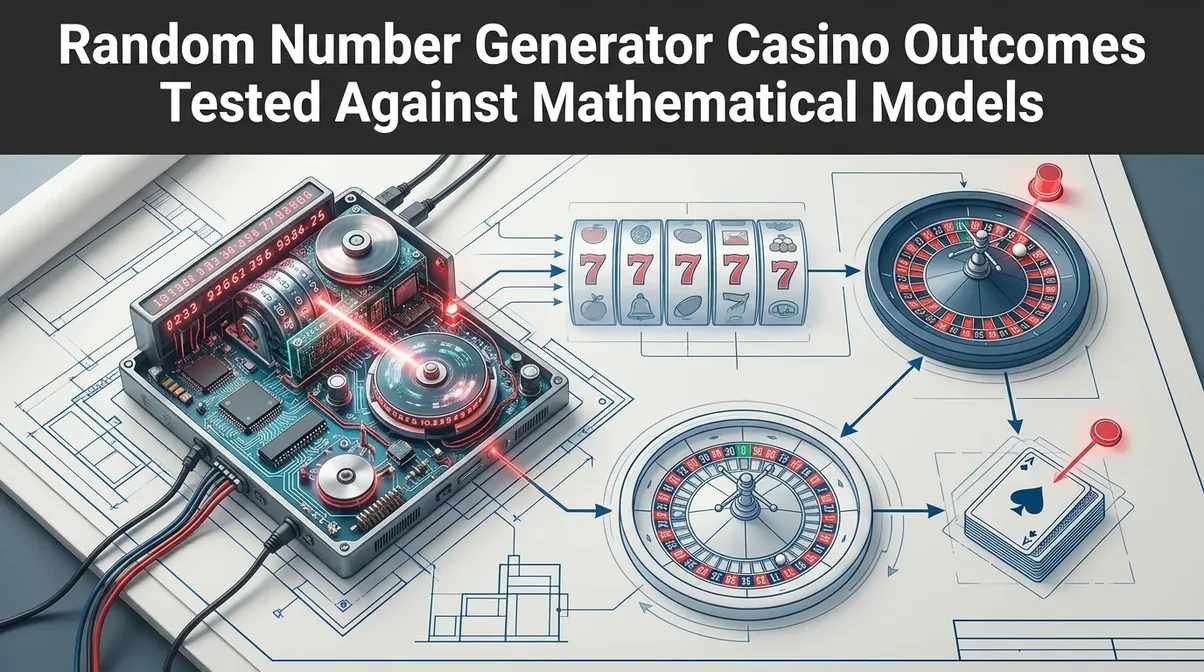
Casinos rely on a random number generator casino system. Either hardware or software generates the numbers. Dealers then use these numbers to decide outcomes in slots, card games, and roulette.
Core Principles Of Casino RNG
Casino RNG systems feature various designs and functions. Each configuration affects certain properties, which in turn determines how the generator produces output and transmits it to the game engine through particular methods.
| Aspect | Clarification |
|---|---|
| RNG type | Hardware or software based |
| Algorithm nature | Deterministic or entropy driven |
| Output range | Large fixed numerical interval |
| Cycle length | Interval prior to sequence repetition |
| Game linkage | Mapping converts numbers to outcomes |
| Timing of calls | Triggered at each game event |
| True RNG source | Physical noise or decay signal |
| Pseudo RNG algorithm | Seeded mathematical sequence |
| House edge link | Set by paytable not generator |
| Player influence | No effect on output values |
Turning Random Values Into Game Outcomes
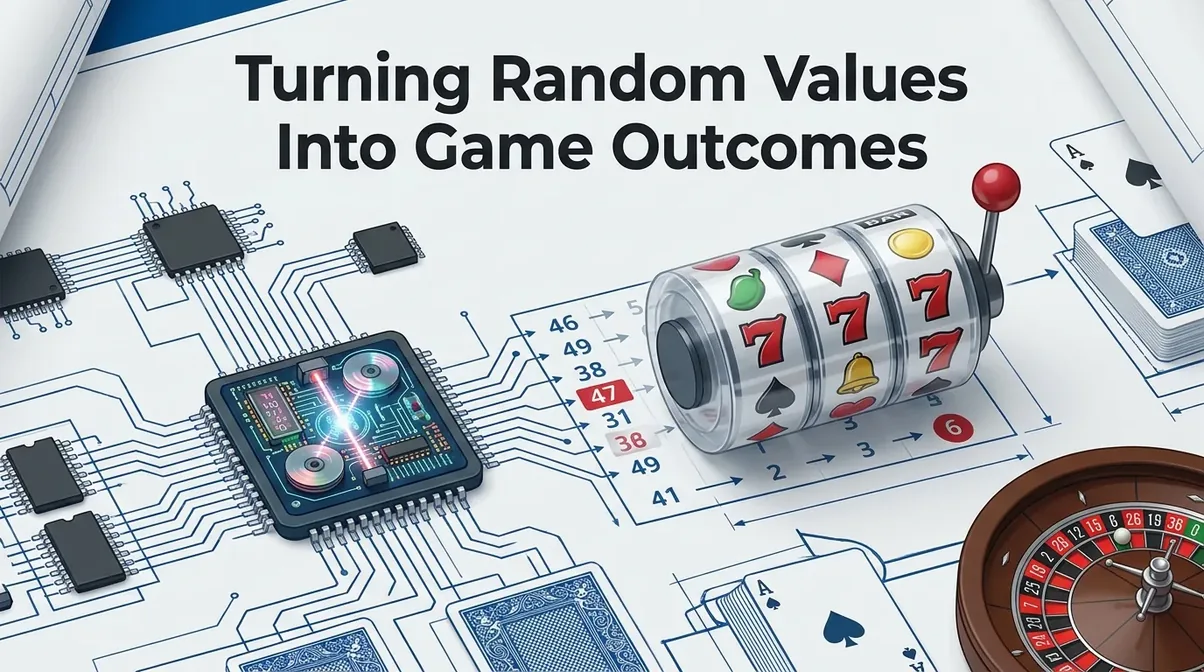
A random number generator casino system starts with an integer that holds no direct value. Developers use scaling and mapping, then establish game rules, transforming the integer into a specific outcome such as a reel position, card draw, or roulette number. Throughout this process, developers make decisions to make sure the final probabilities align with the intended game design. Key elements of this conversion include:
- Raw RNG integer;
- Scaling to ranges;
- Mapping to symbols;
- Card shuffle logic;
- With-replacement draws;
- Without-replacement draws;
- Multi-line slot evaluation;
- Roulette pocket mapping;
- Bonus feature triggers;
- Jackpot selection layer;
Independent Testing Of Casino RNG Systems
Independent technical laboratories operate separately from casinos. Their staff check code created by developers and test the outcomes generated by the code. When a system is submitted, staff follow a set process for checks. Laboratories rely on direct examination rather than accepting statements as evidence. A typical check follows these steps:
- Check submitted documentation.
- Confirm software version checksums.
- Replicate production hardware.
- Capture large output samples.
- Analyze final game outcomes.
- Verify paytable implementation.
- Check mapping fidelity.
- Assess seeding procedures.
- Write formal test reports.
- Specify certified configurations.
Statistical Checks Applied To RNG Output
During casino RNG evaluation, testers apply a series of statistical tests to analyze the output. Each test focuses on a specific property present in the numbers. No test can confirm randomness. Common tests include:
- Simple frequency test;
- Chi-square distribution test;
- Runs up-down test;
- Serial correlation check;
- Gap length test;
- Poker test variant;
- Kolmogorov-Smirnov comparison;
- Autocorrelation at lags;
- Permutation pattern counts;
- Aggregate distribution assessment;
Verifying Outcome Frequencies Against Game Math
Staff check symbol weights and paytables. In the lab, teams compare what they observe for each game to the model. The model provides probabilities for every possible outcome. If the numbers fall outside the limits, staff flag the issues. The verification process includes these steps:
- Define theoretical probabilities: establish expected rates per outcome.
- Calculate expected hit counts: derive target frequencies from the model.
- Choose adequate sample size: select a volume that reduces fluctuation.
- Allow sampling fluctuation: account for natural variance in results.
- Apply significance thresholds: set limits for acceptable deviation.
- Compare rare-event frequencies: examine low-probability outcomes specifically.
- Check jackpot occurrence rate: validate top-prize trigger counts.
- Validate bonus trigger odds: confirm secondary-feature activation rates.
- Summarize deviation statistics: aggregate all difference measurements.
- Flag material discrepancies: report results that exceed defined limits.
Independence Between Consecutive RNG Draws
Each casino draw occurs independently. Analysts check casino RNG output by inspecting data sets. Laboratory teams use specific methods and inspect each draw within the sequence. Common methods include:
- Measure serial correlation;
- Check lagged correlations;
- Run test sequences;
- Analyze symbol runs;
- Compare alternating patterns;
- Inspect multi-reel interplay;
- Test per-position independence;
- Evaluate cross-feature links;
- Summarize dependence metrics;
- Check borderline results;
Checking RTP Volatility And Hit Rates
Laboratories and designers examine RTP, volatility, and hit frequency together, with each metric representing a concrete area of analysis. RNG payout verification and RTP analysis confirm long-term payback percentages and also establish the shape of short-term result swings. Long-term payback percentages and short-term result swings are distinct properties, so testing addresses each separately. Key areas of analysis include:
- Theoretical RTP percentage: the mathematical return calculated from paytable weights;
- Simulated long-run return: observed payback across large-scale trial runs;
- Standard deviation of results: numerical spread around the theoretical mean;
- Distribution of session returns: frequency profile across full play sessions;
- Small-win hit frequency: rate of defined low-value wins per round;
- Feature-trigger frequency: how often bonus mechanics activate;
- Jackpot occurrence rate: statistical interval between top-prize hits;
- Maximum drawdown examples: worst-case loss sequences within test data;
- Time-on-device estimates: projected session length under average conditions;
- Player risk classification: volatility tier assigned based on payout structure;
Inspecting RNG Code Scaling And Mapping
Laboratories check the source code to understand how raw numerical output is transformed into final game results. This process is linked to the security of the random number generator’s source code and seed. Auditors verify that the code implements mathematically correct designs and scrutinize each stage of transformation for unintended distortions. Code checks focus on the following areas:
- RNG function selection: the chosen algorithm must match documented specifications;
- Range bound calculations: numerical intervals must reflect intended probabilities;
- Modulo bias detection: uneven value distribution across ranges receives testing;
- Rejection-sampling logic: auditors confirm proper exclusion of out-of-range values;
- Card shuffle algorithm: auditors verify full permutation correctness;
- Reel weight assignments: symbol probability values match the mathematical model;
- Bonus trigger mapping: defined threshold values align with stated trigger rates;
- Error handling branches: unexpected states do not alter outcome selection;
- Hidden configuration switches: auditors flag undisclosed parameters affecting results;
- Logging of RNG calls: recorded output supports traceability between code and statistical data;
Seeds Unpredictability And Sequence Control
In casino settings, number generators serve as tools for producing random outcomes. Most software generators operate through algorithms, with a seed determining the sequence of results. If the seed becomes known, future values can be predicted. Developers manage the source code and safeguard the seed to prevent such prediction attacks. Hardware generators draw on entropy for their data, while software generators depend on input data. Testers and code auditors check these components to confirm proper function. Audits cover these points:
- Seed initialization sources: where the starting value originates;
- Time-based seeding limits: resolution gaps that reduce unpredictability;
- Hardware entropy usage: physical noise sources supplying initialization data;
- Per-session reseeding rules: frequency of fresh seed injection;
- Protection from replay: controls blocking sequence repetition;
- Isolation from player input: separation of user actions from seed state;
- Audit of seed calls: logged records of initialization events;
- Documented seed ranges: defined boundaries for valid seed values;
- Predictability threat models: documented attack scenarios checked during audits;
- Testing under fixed seeds: verification runs using controlled initialization values;
Certification Reports And Player Interpretation
To verify a casino RNG certification, it is important to check certain details. Each certification report outlines its specific scope. The report presents the findings from the testing laboratory and includes information about the software version, configuration, and mathematical behavior that were examined. Follow these steps:
- Identify testing laboratory: confirm the name of the accredited body that signed the report.
- Note certificate date: confirm the year the laboratory completed the examination.
- Match software version: compare the listed version against the game’s current build.
- Confirm game title: verify the exact game name appears in the document.
- Check stated RTP: cross-reference the certified return-to-player figure with the lobby display.
- Look for scope notes: read any stated limits on what the examination covered.
- Verify jurisdiction listing: check which regulatory authority accepted the certificate.
- Search public registry: find the certificate number in the laboratory’s published database.
- Compare lobby claims: match the advertised figures with the numbers inside the report.
- Note stated limitations: accept that certification applies only to the tested configuration, not future updates.
Streaks, Near-Misses, and Probability
Players observe streaks, clusters, and near-misses as they play. Probability determines the outcomes that unfold over time. Key concepts include:
- Definition of streaks: A streak is a consecutive run of identical or similar outcomes;
- Probability of long runs: Repeated independent trials produce long runs by chance alone;
- Clustering in random data: Random datasets naturally group similar results together;
- Salience of big losses: Large losses attract more attention than equivalent wins;
- Memory of near-misses: A player tends to recall near-misses more vividly than neutral outcomes;
- House edge persistence: The house edge applies across all results regardless of recent patterns;
- Independence of each spin: Each spin carries the same probability as the previous one;
- Misreading short sessions: Short sessions deviate sharply from theoretical return figures;
- Gambler’s fallacy patterns: Past outcomes do not influence the next result;
- Need for large samples: Statistical patterns only become visible across thousands of results;
Conclusion
Testing casino random number generators is important for players. The testing process verifies if game results align with the expected mathematical model and confirms accuracy of the game results. Still, testing does not eliminate the normal fluctuations in game sessions.
FAQ
Can Casino RNG Be Cheated?
Testing laboratories develop and check random number generators to prevent manipulation and interference; although approved systems protect integrity, no certified system guarantees player profit.
How To Check RNG Certification?
Players locate the laboratory logo on the casino homepage and follow the certificate link. This link directs them to the laboratory’s website, where they compare the version details with the information in the laboratory’s database.
Why Do RNG Games Feel Unfair Sometimes?
In casino games that rely on a random number generator casino system, players sometimes go through losing streaks or observe patterns that look familiar. These outcomes tend to occur in clusters. The probabilities and house edge do not change, yet players can still perceive the results as unfair.